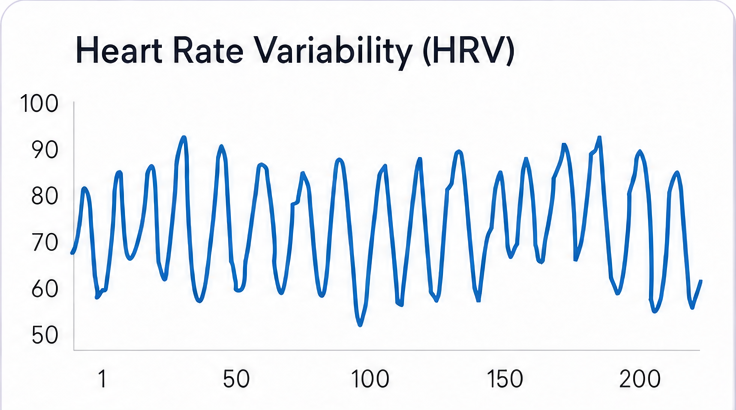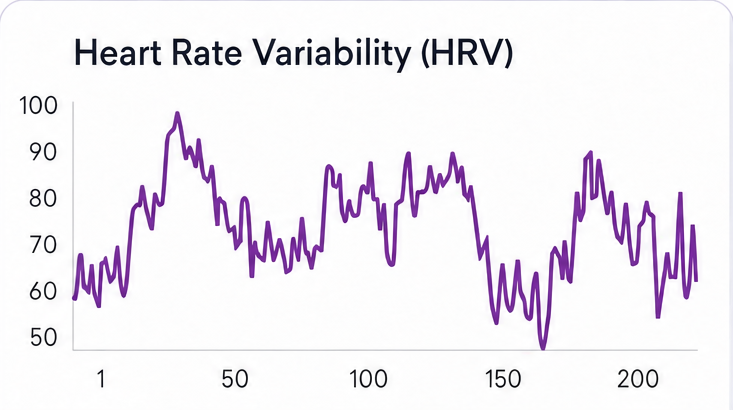
Incoherence — dysregulated
Stressed. Reactive. Drained.
Your system is out of sync. You deplete energy faster, experience clouded thinking, and your ability to handle stress steadily weakens.
- −Worry
- −Frustration
- −Overwhelm
- −Anger
 Book Your Free Call
The Heart - Brain Connection
The answer was in your heart the whole time.
Your heart is in constant communication with your brain, sending signals that help shape how you think, feel, perceive, and respond to the world around you. In fact, the heart sends more signals to the brain than the brain sends back to the heart.
For over 35 years, the HeartMath Institute has studied heart rhythm variability (HRV) and the heart-brain connection, contributing to a growing body of research exploring how cardiovascular signals influence brain function. Peer-reviewed studies show that signals from the heart can affect attention, emotional processing, memory, and decision-making.
But this communication extends beyond the brain alone. The heart is deeply connected with the Nervous System, hormonal activity, and the body’s Electromagnetic field, creating a continuous exchange between our physiology and our state of mind. This is why we cannot always simply “think our way” out of stress as the response is being carried through an entire interconnected system.
Incoherence & Coherence
How we manage our Emotions is what sustains heart coherence.
Breathing can start the shift but emotion is what helps create and sustain coherence. Feelings such as appreciation and active recognition, gratitude and felt thankfulness, along with care and compassion toward yourself and others, help move the heart into a smoother, steadier rhythm and keep it there. That coherent rhythm sends the brain a clearer signal of safety and balance, helping settle the nervous system and shift the body out of stress. That’s what coherence feels like: calm, clear, grounded, and more in control.
Over 17 years, the HeartMath Institute followed 14,266 people using a validated scientific assessment. Participants reported improvements in stress, sleep, and energy.
These outcomes don’t come from tracking stress.
They come from the daily practice of training your nervous system.
The Working State
Coherence is not calm, and it is not a mood. It is an ordered relationship between systems: the breath, the heart’s rhythm and the branches of the autonomic nervous system moving in a single smooth pattern rather than pulling against one another. On a monitor it appears as a rounded, wave-like rhythm in place of a jagged one.
The state is reachable deliberately. Slowing the breath toward six cycles a minute, letting attention rest in the chest, and holding a genuinely felt appreciation will each shift the rhythm within a minute or two. Held for longer, the shift travels outward into hormone balance, immune signalling, sleep, and the clarity with which a person can think under pressure.
What makes this practically useful is that it is trainable and measurable. It is not a belief about the heart. It is a physiological skill, and like any skill it improves with repetition.
"When the heart settles into order, the body stops bracing. Everything downstream: thought, digestion, repair, and the capacity to be kind, gets easier."
Your Two Great Transmitters
Of everything in the body, two organs generate the most powerful, most far-reaching electromagnetic fields: the heart and the brain. When the two of them start speaking the same language, a state researchers call coherence emerges and something measurable shifts, from the rhythm of your heartbeat down to the rhythm of your genes.
According to research from the HeartMath Institute, the heart’s electrical field is roughly sixty times greater in amplitude than the brain’s, and its magnetic field is more than one hundred times stronger — detectable up to three feet outside the body. The brain, meanwhile, generates its influence through frequency rather than raw amplitude, cycling through four recognized brainwave states: Delta, the deep, restorative frequency of dreamless sleep where the most physical healing occurs; Theta, the gateway to memory, intuition, and meditation; Alpha, the calm, coordinated resting state of an awake mind; and Beta, the fast, active frequency of focused, waking thought.
Neuroscience researcher and author Dr. Joe Dispenza points to coherence — the state in which the heart’s rhythm and the brain’s waves synchronize — as the physiological signature of the body’s highest capacity for healing. This isn’t abstract: sustained heart-brain coherence, cultivated through practices like heart-focused breathing, gratitude, and meditation, has been associated in published research with a documented shift away from the stress-dominant sympathetic nervous system and toward the restorative parasympathetic state — lower cortisol, higher DHEA, and, over time, the kind of neuroplastic change that lets a new emotional pattern become the new default rather than an effortful override.
The heart holds roughly forty thousand neurons of its own, enough to sense, remember, and make simple decisions without instruction from the brain. Far more nerve traffic travels upward from the heart than downward toward it. In the ordinary running of a day, the heart is speaking more than it is being spoken to.
It speaks in more than one language. Through nerves, through pressure waves, through hormones it manufactures itself, and through an electromagnetic field that extends past the surface of the skin. Each of these channels carries the same underlying information: whether this body, right now, is safe.
That is why emotional states are not experienced as abstractions. Fear, grief, gratitude and love each arrive with a distinct cardiac signature, and the rest of the body organises itself around whichever one is broadcasting.
In the ordinary running of a day, the heart is speaking more than it is being spoken to.
Heart rate variability, or HRV, is the tiny variation in time between each heartbeat. Even when your pulse feels perfectly steady, the gaps between beats are always shifting. That variability isn’t noise; it’s information. A heart that can shift rhythm quickly and smoothly belongs to a nervous system that recovers well from stress. A heart locked into a rigid, low-variability pattern belongs to one running on reserve.
The HeartMath Institute has tracked this relationship for more than three decades, building an evidence base of over eighty peer-reviewed studies. Their research distinguishes two patterns: an incoherent heart rhythm is jagged and erratic, associated with worry, frustration and overwhelm. A coherent heart rhythm is smooth and ordered, associated with appreciation, care and calm focus. The rhythm itself is a readout of what’s happening several layers deeper: in the nervous system, the hormones, and, as more recent research is showing, the way your genes are being read.
That variability isn’t noise; it’s information.
HRV is strongly influenced by vagal activity, but HRV is not synonymous with vagal activity. HeartMath Institute describes heart-rate variability as emerging from the interaction of autonomic neural activity, respiration, blood-pressure regulation and higher-level control systems, while also recognizing the influence of breathing, exercise, thoughts and emotions.
Broader HRV research extends this picture further, showing that sleep, circadian rhythms, inflammation, illness, hormones, hydration, metabolic state, medications, stimulants, posture, environmental conditions, age and individual biology can also influence the rhythm we measure, with many of these factors also influencing vagal signalling itself.
The heart and brain are wired together largely through the vagus nerve, and the traffic runs mostly in one direction, from heart to brain. The majority of vagal fibers carry ascending signal: what’s happening in the heart, informing the brain’s state before a single conscious thought has formed. This is part of why a person can’t simply think their way out of a stress response. The body has to register safety first; the mind follows.
That heart-to-brain signalling doesn’t travel by nerve alone. HeartMath Institute research maps four parallel channels: the nervous system, the biochemical and hormonal system, the biophysical pulse wave that moves through every blood vessel with each beat, and the heart’s own electromagnetic field. Four transmission lines, carrying the same underlying message about your state to every cell equipped to receive it.
The body has to register safety first; the mind follows.
Four channels, one message: whether this body, right now, is safe.
Practiced consistently, heart-focused breathing, gratitude and meditation build what researchers call a vagal brake which is a greater capacity to downshift out of sympathetic alarm and back into parasympathetic access: access to clear thought, digestion, immune function, and repair. A dysregulated nervous system stays tilted toward alarm even when nothing in the room is actually dangerous.
This is the physiology underneath every meridian, chakra and radiant-circuit. Whatever restores nervous-system regulation restores energetic flow, because they are two descriptions of the same event, seen from two different vantage points.
In 1983 the heart was formally reclassified as part of the endocrine system, after researchers discovered it manufactures and releases its own hormone called atrial natriuretic peptides which helps regulate blood pressure and fluid balance, and appears to play a role in motivation and behavior as well. The heart also produces oxytocin, the hormone associated with bonding, trust and felt safety, once thought to originate only in the brain.
Alongside this hormonal traffic, sustained coherence practices have been associated with lower cortisol and higher DHEA, a shift away from the body’s stress hormone and toward its restorative one. Over time, that hormonal shift is part of what lets a new emotional pattern become the default rather than an effortful override.
Low HRV doesn’t only track stress, it tracks inflammation. Across a number of studies, people with reduced heart rate variability show measurably higher levels of inflammatory activity. The proposed mechanism runs back through the vagus nerve: efferent vagal signalling releases acetylcholine at sites throughout the body, and acetylcholine tells nearby immune cells to stand down, dialing back the release of inflammatory messengers. Researchers call this the cholinergic anti-inflammatory pathway.
In practice, this means a chronically dysregulated nervous system isn’t just a background stressor. It’s an active driver of the low-grade inflammation implicated in a wide range of chronic conditions. A coherent one is part of what keeps that inflammatory response in check.
The stress a nervous system carries doesn’t stop at emotion or hormone. It can reach into gene expression itself. Emerging research links heart rate variability to methylation patterns on the gene that codes for the body’s stress-hormone receptor, meaning the same nervous-system state read in a heartbeat also appears to show up in how that gene gets expressed.
This is still an active, developing field of study but the implication is significant. Patterns of fear, hypervigilance or felt safety may not only be learned; they may be encoded. Which means coherence work may reach further than the moment it’s practiced in.
Everything above describes a loop, not a one-way street. Chronic stress dysregulates the nervous system, which unbalances hormones, which feeds inflammation, which further destabilizes the nervous system and the same loop runs in reverse, toward health. Energy psychology methods such as tapping, meridian-based techniques, heart-focused breath-work interrupts that loop directly at the body, rather than only at the level of thought.
Randomized studies on tapping (EFT) have recorded cortisol reductions in the range of roughly a quarter to nearly half after a single session, alongside measurable improvements in heart rate variability, immune markers, and, in preliminary findings, the expression of genes tied to immunity, stress response and emotional regulation. It’s the same mechanism this whole section has been describing: work the meridians, the breath, the felt sense of safety in the body, and the nervous system, hormones, inflammation and gene expression follow. This is why Holistic Energy Medicine treats a symptom as a signal rather than an isolated event. By the time distress shows up as pain, fatigue or illness, it has already moved through every layer described here.
None of this makes the heart a metaphor. It’s a working transmitter, and its signal is legible: in a heartbeat’s rhythm, a hormone panel, an inflammatory marker, and a strand of methylated DNA. Coherence isn’t a mood. It’s a measurable state the whole body organizes around, for better or worse, which is exactly why restoring it sits at the center of this work.
Pause with us · One minute
Breathe in for five seconds as the flower opens, and out for five as it closes. This steady rhythm is the simplest way to bring the heart into coherence.
Receive the free 7 day Heart Coherence practice, one short breath each morning, straight to your inbox.