
Know Thyself! What Is the Inner Path?
By Avo Garboushian ·
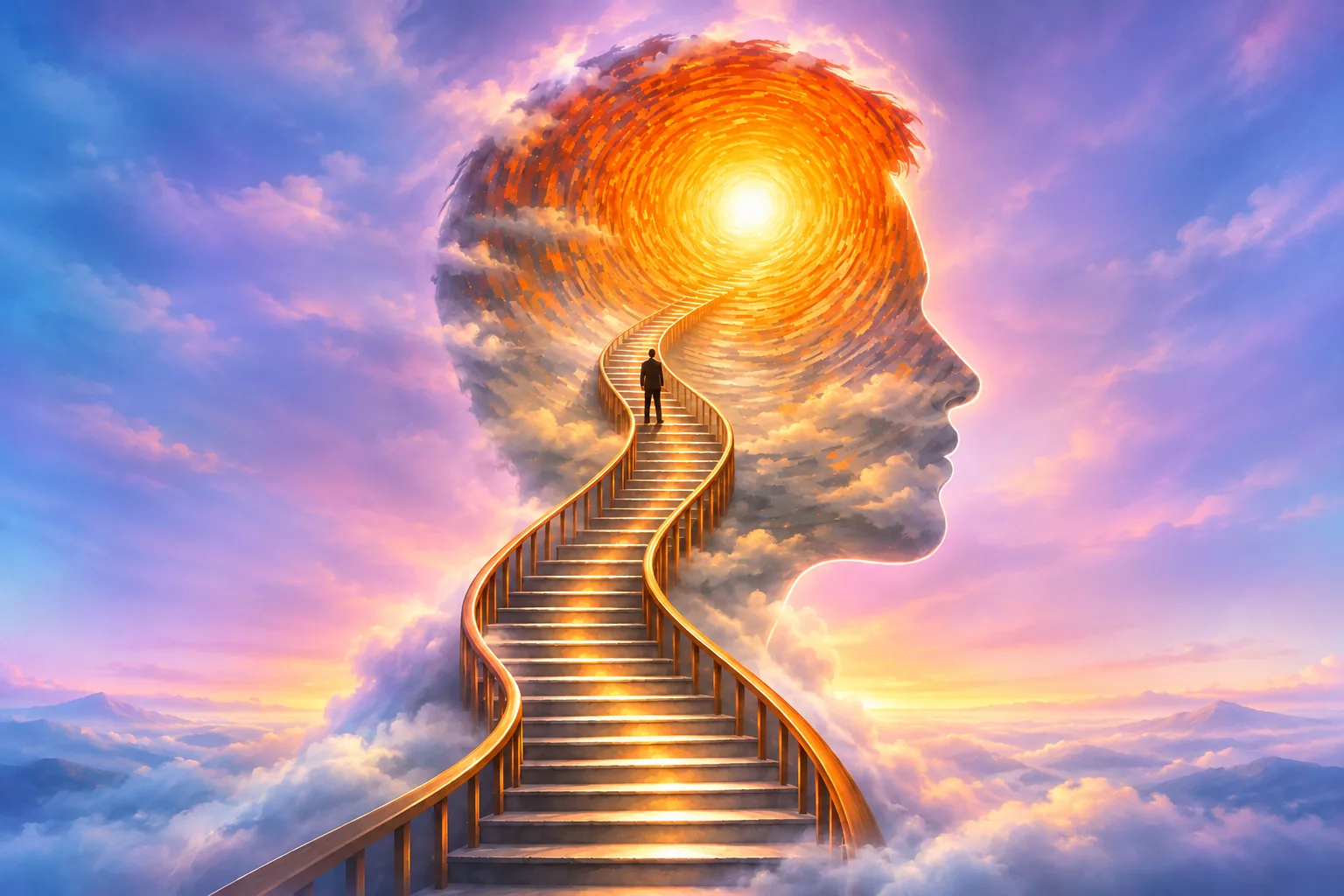
More than two thousand years ago, pilgrims climbing to the Temple of Apollo at Delphi met a short inscription: Know thyself. The Greeks argued about what it meant. Socrates took it up as the work of his life, and at his trial he said that the unexamined life is not worth living. Read plainly, the saying is an instruction, and it asks for something most of us put off for as long as we can: to turn around and look at the one who is looking.
“The unexamined life is not worth living.”
Socrates, in Plato’s Apology
The faiths of the Middle East and the West give the same instruction in their own voices. Jesus told his listeners that the kingdom of God is within you, and that “you will know the truth, and the truth will set you free.” The Psalms invite the same turning inward: “Be still, and know that I am God.” The Quran asks, of the signs of creation, “and in yourselves as well. Do you not then see?” The Sufi tradition, and Ibn Arabi after it, cherished the saying “He who knows himself knows his Lord.” And the Torah's call to “love thy neighbour as thyself” quietly assumes that we have first learned how to love ourselves.
“The kingdom of God is within you.”
Luke 17:21, King James Version
In India the question became a whole science. The Upanishads announce tat tvam asi, you are that, and offer a prayer every seeker can say: “Lead me from the unreal to the real, from darkness to light, from death to immortality.” Patanjali listed svadhyaya, self study, among the practices of yoga. The Bhagavad Gita says: “Elevate yourself through the power of your mind, and not degrade yourself, for the mind can be the friend and also the enemy of the self.” The Buddha opened the Dhammapada with these words: “All that we are is the result of what we have thought.” In China, Lao Tzu wrote: “He who knows other men is discerning; he who knows himself is intelligent.”
“Lead me from the unreal to the real, from darkness to light, from death to immortality.”
Brihadaranyaka Upanishad 1.3.28
Consider those three words more closely. Tat tvam asi, in Sanskrit, is one of the four great utterances of the Upanishads, the Mahavakyas. Tat means that, the supreme reality, the Absolute. Tvam means you, the individual self. Asi means are. You are that. The declaration is that the individual soul, the Atman, is not separate from the ultimate, universal consciousness, Brahman, and that realizing this unity removes ignorance and the illusion of personal separation. Put as a story, it goes like this.
Imagine a river that has forgotten it is water. It begins as a small stream in the mountains, and the first things it learns are its own name and its own banks. It is this river, not that one. It grows proud of its shape, anxious about its course, and afraid of the day of its own demise when it will meet the sea. This is how most of us live: identified with the banks, the names and forms, the endless chatter of the surface. In the Chandogya Upanishad, a sage named Uddalaka tries to wake his son Shvetaketu from exactly this forgetting. He points to the rivers flowing east and west, and says that once they reach the sea they become the sea, and no river says, “I am this one” or “I am that one.” Then comes the statement that has echoed for more than two and a half thousand years: tat tvam asi. You are that.
“You are not a drop in the ocean. You are the entire ocean, in a drop.”
Rumi - Sufi mystic, poet
The Sufi poet Rumi carried the same river to the sea in his own language. In ordinary logic a drop is a tiny, insignificant piece of the ocean. In essence the drop is the ocean, made of the same water, and Rumi is telling the individual that their true nature is the Infinite. The Sufis call the meeting Fana, the dissolving of the ego self, the way salt melts into the sea. The Upanishads call it Moksha, liberation through non-duality. Nothing dies when the river enters the ocean. It only loses its narrow banks, and claims its true, limitless identity as the vast waters. Two traditions, two languages, one river.
Rumi also pointed to how the river finds the sea: “Silence is an ocean. Speech is a river. When the ocean is searching for you, don’t walk into the river. Listen to the ocean.” The river is the world of names, forms, definitions and passing thoughts. The ocean is the silent, underlying reality that the Vedic seers called the ultimate reality, the absolute truth. This is the inner path in a single image. We sit in meditation, follow the breath and study our own emotions, not to become someone new, but to look past the noisy, moving surface and rest in the vast expanse we already are.
Place these voices side by side and a pattern appears. Each of them asks us to look at something we already have: the breath that carries the state of our nervous system, the emotions we feel and the ones we avoid, the mind that explains them, the energy underneath, and the quiet awareness that notices all of it. This is what is called the inner path. It begins with a willingness to look within, sincerely and without judgment, and it moves through breath, emotion, mind and energy toward knowing ourselves and loving ourselves completely. I finally answered the call of the question that lay dormant within me, after a cycling accident in 2010 as I was sprawled on the street and asked myself: Who am I? Everything that followed grew from that question that has led me here today, to the recognition that Who am I? is never answered by the mind alone. It opens the seeker, layer by layer, to the stillness beneath thought, to the awareness that was watching all along, and to the quiet discovery that the one who is searching is the very Self being sought.
The inner path is not a belief system, and it is not an escape from life. It is the practical work of turning our attention inward until we can see what drives our thoughts, our emotions and our choices. Without it we live on autopilot, reacting to the world from wounds we never looked at and calling it personality. With it, we begin to choose. This is why knowing ourselves matters now more than ever. We are the most connected generation in history, and many of us feel more inwardly disconnected than ever, with anxiety, loneliness and exhaustion part of everyday conversation. A world that gains power faster than it gains self understanding will use that power from its fears. Every conflict, every division and every crisis is first lived out in the lower mind, understood through our higher self, and resolved through the heart, and that is where lasting change has to begin.
Blaise Pascal saw the danger in the seventeenth century, long before mobile phones and computer screens. In the section of his Pensées that he titled “Diversion,” he wrote: “I have discovered that all the unhappiness of men arises from one single fact, that they cannot stay quietly in their own chamber.” Today the diversion is endless, personal and always within reach, and much of it is designed to hold our attention. A mind that never rests never meets itself, and a person who has never looked at what impacts their own fears, insecurities, beliefs, and cravings and desires in life is easy to influence. This is why self knowledge is also a form of freedom. When we understand what moves us beneath the surface, we become much harder to provoke, to sell to and to impact our decisions. Outrage loses its grip on a person who understands the root of their own anger, advertising loses its power over the awareness of why we have cravings, and manipulative tactics lose their leverage once we understand what triggers our emotions, because a trigger we have seen clearly can no longer decide for us. The endless scroll loses its pull in the same way: when we no longer need a social media feed to tell us whether we are enough, comparison has nothing left to feed on. We also grow more patient with others, because we recognise in their faces the fears and insecurities we have finally learned to see in ourselves.
“I have discovered that all the unhappiness of men arises from one single fact, that they cannot stay quietly in their own chamber.”
Blaise Pascal, Pensées, no. 139
Carl Jung, the Swiss psychiatrist who gave us the language of the shadow, saw that we rarely meet other people as they truly are. What we have not yet made conscious in ourselves, we tend to see in others. The anger, envy and fear we refuse to own seem to belong to someone else, and so does the goodness we have not yet claimed. Once we understand that so much of what others do is a projection, we stop taking things so personally. A person who lies to us is lying to themselves. A person who tries to deceive us has been deceived themselves. And a person who is kind and uplifting toward us speaks to themselves in that same way. No one can give us what they do not recognize within themselves, good or bad. Someone who has never felt at peace within themselves cannot offer us peace, and someone who is always judging themselves will often judge us too. Seeing this allows us to accept where each person is on their own journey in life. This does not excuse harmful behaviour. It simply means we can stop waiting for them to change and expecting people to give us what they are not yet prepared to recognize within themselves that needs healing. We can meet them with compassion, set healthy boundaries where we need them, and keep growing ourselves.
“Everything that irritates us about others can lead us to an understanding of ourselves.”
Carl Jung, Memories, Dreams, Reflections
The same is true for us. We can only give the world what we possess. If we want to show up kinder, calmer and more confident, it begins with the way we speak to ourselves. Viktor Frankl, the psychiatrist who survived the Nazi concentration camps, discovered that even there, one specific freedom could never be taken away. In Man’s Search for Meaning, he wrote: “Everything can be taken from a man but one thing: the last of the human freedoms: to choose one’s attitude in any given set of circumstances, to choose one’s own way.” We cannot always choose what others project onto us, or what life places in our path, but with self awareness we can choose how we meet it. Without that awareness, we simply react.
This is why The Love Trumpet was created. Most of the world’s education systems do not teach self-awareness. We are not born with an instruction manual, yet we need one. We are taught to absorb information, follow instructions and pass tests, but rarely are we taught how to understand ourselves. Without the practical tools to examine our thoughts, emotions, beliefs and the forces that shape our perceptions, we become vulnerable to ideologies that exploit our fears, insecurities and desires, turning the mind into an instrument of coercion and control. When we identify too closely with what we have been taught to believe, we can lose the ability to distinguish our own awareness from the ideas we have inherited or accepted without question. To know ourselves is to develop the discernment to look beyond the surface of our thoughts and emotions and understand what drives them. This requires more than intellectual understanding; it requires practices that allow us to observe the mind rather than simply follow it, because the truth of who we are and the deeper understanding of our existence rest beyond the thinking mind.
The Love Trumpet exists to share the practical techniques and guidance that help us cultivate this awareness. Through meditation, breathwork, also known as pranayama, mindfulness and the study of cause and effect, we can begin to understand the fluctuations of our minds, our emotional responses and the patterns that influence our choices. With proper guidance, these practices give our search to answer the question Who Am I? a foundation built on self-examination, discernment and direct experience rather than intellectual pursuit alone. They do not compete with any faith or belief system. In fact, they can complement those who follow a religion, helping them deepen their inner connection with the Creator through greater stillness, awareness and understanding. Awareness of the importance of mindfulness and self-awareness in education is growing, and The Love Trumpet exists to help that awareness grow. Our vision is a world where love becomes our organizing intelligence, where self-awareness is cultivated from childhood through adulthood, and where healers and organizations rise as one united voice to raise the standard of our highest wellbeing through awareness.
It starts with the first steps of being open and willing to look within: sitting quietly, following the breath, and watching what arises without turning away. Tonight, put your phone in another room and sit with yourself for five minutes. Ask the question Delphi asked: Who am I? Notice what rises, and meet it without judgment. Then care for your inner wellbeing, your mind, your body, your emotions and your spirit, as you would care for someone you love, because the world we are building asks that of each of us: I will take great care of myself, for you.
Sources and translations. Plato, Apology; John 8:32 (New International Version); Luke 17:21, Psalm 46:10 and Leviticus 19:18 (King James Version); Quran 51:21 (Aisha Bewley translation); the Sufi saying “He who knows himself knows his Lord,” as cited by Ibn Arabi; Brihadaranyaka Upanishad 1.3.28; Chandogya Upanishad 6.10 (the rivers and the sea); words attributed to Rumi, as widely rendered in English (the wording varies between translations); Bhagavad Gita 6.5 (Swami Mukundananda translation); Dhammapada, verse 1 (F. Max Müller translation); Tao Te Ching 33 (James Legge translation); Blaise Pascal, Pensées 139. Carl Jung, Memories, Dreams, Reflections. Viktor Frankl, Man’s Search for Meaning. Wording varies between translations.